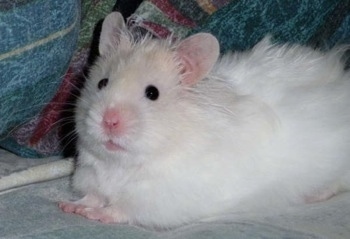
Hamster Breed Chart

Hamster Breed Chart

Type

Scientific Name

Other Names

Origin

Size

Lifestyle

Life Span

Colors

Syrian

Mesocricetus auratus

  • Golden
  • Teddy Bear
  • Standard
  • Fancy

Syrian Desert

4" to 7"

Solitary after 10 weeks of age

2 to
2-1/2 years

Wide variety

Dwarf Campbell Russian

Phodopus campbelli

  • Campbell
  • Djungarian
  • Dzungarian
  • Russian

Asia

about 4"

Colonial in same sex pairs or small groups

2 years

Wide variety

Dwarf Winter White Russian

Phodopus sungorus

  • Djunarian
  • Siberian

Russia, Asia

3-1/2" to 4"

Colonial in same sex pairs or small groups

2 years

Sapphire, Pearl, Sapphire-Pearl

Roborovski Dwarf

Phodopus roborovski

  • Roborovski
  • Mongolian

Mongolia

1-1/2" to 2"

Colonial in same sex pairs or small groups

3 to
3-1/2 years

Sandy brown

Chinese

Cricetulus griseus

  • Striped hamster
  • Chinese striped hamster

Southern China, Mongolia

about 4"

Solitary

1-1/2 to 2 years

Brown backs, black fur along spine, and ivory coloring


Tuesday, June 11, 2013

Will Pet Hamsters Released Into The Wild Survive?

Pet hamsters released into the wild will most definitely not survive. Your hamsters were reared as pets by a mother that was a pet herself. That's your hamsters’ only scope of reference. For hundreds of generations, hamsters have been selected for characteristics that make them good domestic pets, not survivors in the wild.
Death for a domestic hamster outdoors would probably be slow and painful. Rescued hamsters found outside are often near death from exposure or malnutrition. In the wild, your hamsters could become prey to animals that live their lives outdoors finding their own food. Your hamsters would likely pick up parasites for which they have no natural resistance. The terrain is very different than the cage bedding they’ve known, meaning they wouldn’t be able to dig for warmth or safety.

Releasing hamsters into the wild is likely illegal, as well. Animal cruelty laws protect pets from such treatment. Environmental laws protect native plant and animal species from the threat posed by the release of nonnative species.

Many animal shelters help in situations like yours by accepting small animals — call first or check out their acceptance guidelines on the agency’s website. There are several hamster and small animal rescue groups that can assist you, as well. Do an online search using “hamster rescue” to find these.

All About Older Hamsters

At the age of 2, your hamster is reaching the end of its life span and can be called a senior. By this time dietary needs and behavior may have changed. Older hamsters obviously are not as active as they once were. They sleep more and do not respond as quickly to being called. Older hamsters still enjoy outings in a playbox but move more slowly.

Many old hamsters put hard food from their dry hamster mix into their milky porridge or soft food to soften it. Soft foods such as porridge provide hamsters with easily digestible gluten from the oats. Your senior hamster will enjoy unseasoned, cooked foods such as boiled rice, boiled potato or pasta because they’re soft and easier to digest.

Another side effect of a hamster turning 2 years old is that its fur may begin to thin. Longhaired Syrian males might need to have their hair trimmed, especially if they lose interest in grooming themselves. You might say the hamsters have become lazy!

Older hamsters benefit from having extra bedding in their cages to act as insulation, especially if their fur is thinning or if bald patches are developing. If a hamster’s eyes do not open readily or appear “gummed up,” they can be eased by gentle bathing with warm water.

The life expectancy of a hamster is around 2 years. As with their human counterparts, some will live to a ripe old age while others will die before their time

Saturday, May 11, 2013

Can I change my hamster's sleep schedule?


It is possible to change a hamster's sleep schedule. It's not easy, and it may not be permanent, but it's possible. We're speaking here about Syrian hamsters, which must be kept in cages by themselves. Dwarf hamsters will respond similarly, but their behavior may be affected by their cagemates, and thus may not be as readily changed.
A hamster's behavior is mostly determined by the environment and repetition. The Syrian hamster has been kept as a pet for less than one hundred years. For perhaps tens of thousands of years prior to that they each lived in desert burrows, alone, responding only to their personal survival needs and the weather, which, being on a desert plain, hardly changes. So when a Syrian hamster enters your home, he or she is carrying on the kind of activity that's written into its DNA. That's the long way of saying hamsters are truly "creatures of habit."
Iggy the Teddy Bear Hamster at 4 months old. The key, then, to changing a hamster's wake/sleep schedule is to create a gentle transition in the way their day goes. Remember that "personal survival needs" mainly involve getting food. In the wild this activity is initiated by the hamster, which has a sense that it should go out every day and gather things. But in your home, you're the food source, so you must create a pattern to imitate nature.
To do this, toss away the food in your hamster's dish and replace it at a set time daily. There's a side note here: Your hamster’s diet is a separate subject altogether, but in short, it's not a good idea to limit it to a store-bought mix, and to simply refill the supply when it gets low. First, the hamster will eat what it wants, and leave what it doesn't, which may lead to malnutrition. Second, grains oxidize and lose their nutritional value, and the oils become rancid. Finally, fresh foods provide a wide variety of active nutrients, and hamsters like them, so they offer a good incentive for training.
With that said, back to "time-shifting your hamster": Take note of when your hamster typically rises in the evening, and set out a dish of food around then. The dish should include some fresh items for the reasons above, and because these send an aroma signal to the hamster that reminds it of its need to "go out and gather." Set the dish near the cage if your hamster is sleeping soundly so the smells can trigger your hamster’s wake-up call instead of startling it by placing it in the cage. Your hamster will see this as a focal point of the day, and it will begin to order its activities around it — eating, running, grooming, napping and so on. It's like a delicious, life-enhancing alarm clock!
If you're truly consistent, meaning that you perform this food change at exactly the same time every day, it will take most hamsters only a week to get a fix on it and react consistently as well. Then the process is simple. Just move the time you do this up or down by 15 minutes every five days or so. Again, you're going to have to be very, very regular about it. This method has been known to change a hamster's sleeping and waking time by as much as an hour over the course of a month.
Please note that when we change our clocks for daylight saving time, if that applies to you, we're sort of doing the same thing to ourselves. Our hamsters, in turn, will react to changes in our activity, light and dark, noise level, and so on. That will also alter their waking and sleeping patterns.
Eventually your hamster may just wander off the schedule for reasons that can't be explained except to say that occasionally doing the unexpected is one reason we love hamsters so much

Thursday, August 2, 2012

Hamsters ready to return for new batch of KIA Soul ads

Kia Hamsters
We certainly hope you like seeing hamsters during your commercial breaks. Kia is readying a new volley of ads for the 2013 Soul featuring the fuzzy little rodents doing what they do best, according to Automotive News.

This will mark the fourth generation of Kia hamster ads, and the clever spots have been big for both the budget hatchback and the automaker in general. While speaking at the Small Agency Conference hosted byAd Age, Michael Sprague, the executive vice president of marketing and communications for Kia, said the manufacturer's sales have jumped by 78 percent since 2008. At least a portion of that increase can be attributed to the success of the hamster campaign.

Sprague also revealed the hamsters were almost edged out by other members of the animal kingdom, including backpack-wearing boars. So, what's behind Kia's marketing success beyond a handful of anthropomorphic rodents? Sprague says Kia can thank its success to the company paired-down, bureaucracy-free management system. When it comes to pitching marketing ideas, the only person he has to answer to is the company's CEO.

Saturday, July 28, 2012

When your hamster has babies......


Hamsters are lively, adventurous pets and give their owners hours of enjoyment. If an owner has two or more hamsters they may find themselves in a situation of mistaken gender identity. Hamsters can reproduce at an early age of 6 to 8 weeks. Once pregnant, a female hamster's gestation period is only 2 weeks (14 days). If you are lucky enough to know your hamster is pregnant, you'll want to be sure to separate her from any other hamsters and give her a quiet area. Make sure she is eating a healthy diet. Hamsters love carrots and other raw vegetables as well as the normal hamster diet you can get from any pet or retail store. Remember to provide your hamster with plenty of water.
A clean, dry cage is a happy home! Be sure you provide a spacious, clean, dry cage. Cedar litter and shredded newspaper are favorites of hamsters. Hamsters are very efficient at making comfortable nests to sleep or bury themselves in, so be sure you offer plenty of bedding material for them to work with. The bedding material will also provide a hiding place and privacy for the mother and babies. Even though she has babies, your female hamster may decide to go exploring while the babies are asleep. Hamsters love to climb and explore and are very good at it! Remember that hamsters are escape artists, so make sure the cage is escape proof and deep! Keep your hamster happy with an exercise wheel and hide treats throughout her cage to keep her active. Chew sticks will allow her to keep her teeth trimmed and relieve any anxieties she may have. Try not to hold or disturb your female hamster when she is pregnant.

Hamster babies are born bald and pink and are about the size of jellybeans. Their eyes are tightly closed. Within 3 to 5 days their fur starts to grow in. Once the babies are born it is alright to offer your female hamster some extra nourishment. I gave my hamster small amounts of diluted canned milk or full 2% milk along with her water while she was nursing. It is necessary to clean your hamster's cage once a week, so you will have the opportunity to hold the little ones often. If your hamster is used to your presence and being held, she should have no problems with you gently removing the babies and her to clean the cage. I held my hamster's babies when they were able to crawl around with no problems from their mother. You can separate the babies from their mother around 3 to 4 weeks of age. Hamsters are prolific like other rodents, so make sure you separate the sexes as soon as they stop nursing.
A clean, well-fed, exercising mother hamster is a happy one. Hamsters make excellent mothers if you give them the right care, diet and materials to raise their family.

Friday, March 30, 2012

Medicines that Hamsters are alergic to


Here is a list of what type of medicines hamsters are alergic to:  Only give these medicines on the advice and perscription for a veterinarian.

Streptomycin 
Dihydrostreptomycin 
All penicillins 
Lincomycin 
Clindamycin 
Erythromycin 
Tylosin 
Some Cephalosporins 
Ampicillin 
Amoxycillin 
Tetracycline